Guides › Which vitamin D test do you need
Which vitamin D test do you actually need, and when is it free?
By the WhereToStart editorial team · Written to NHS, NICE, USPSTF and Ontario Health guidance · Last reviewed · 8 min read
This guide contains links marked Sponsored. They pay us a commission and never change our advice. How we're funded. It has not yet been independently reviewed by a clinician; here is how we check it.
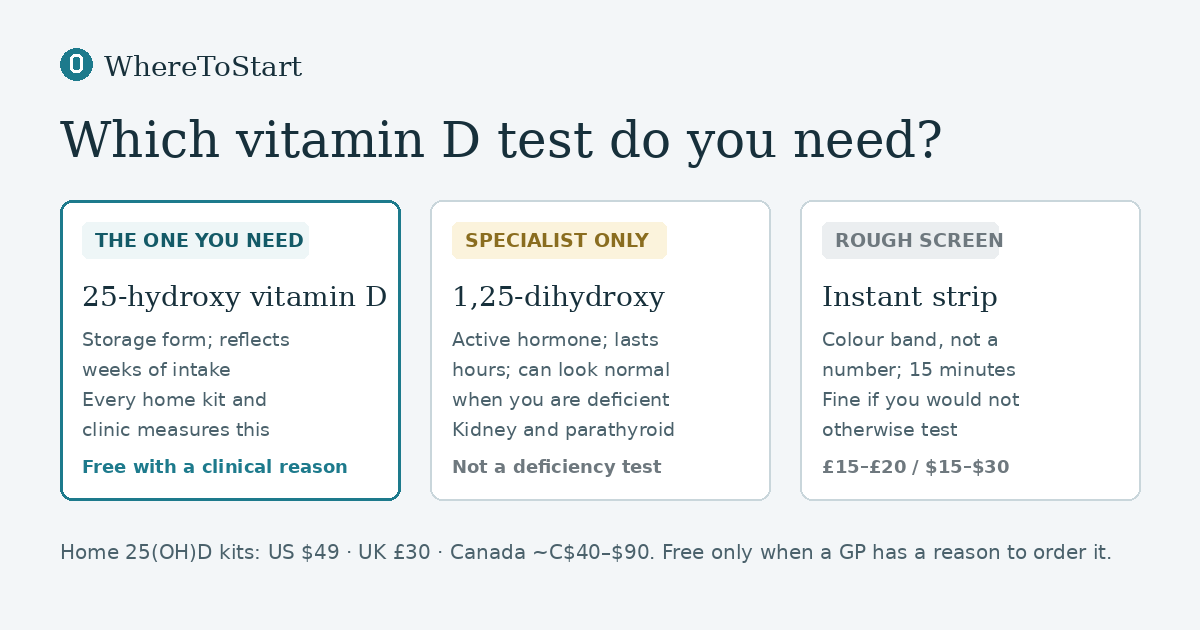
Quick answer: You need one test: 25-hydroxy vitamin D, written as 25(OH)D. Every home kit and every clinic measures it. It is free through a GP or clinic when you have a reason the health system recognises (bone disease, malabsorption, kidney disease, certain medicines, or symptoms); for a general check it is usually paid, and a kit (US $49, UK £30, Canada about C$40–$90) is often the cheapest way.
In this guide
Who should test, and who can skip straight to a supplement
Vitamin D is unusual among blood tests: for a healthy adult with no symptoms, the official advice in all three countries is not to test at all. The US Preventive Services Task Force found the evidence for screening insufficient, NICE guidance in the UK says routine testing is not needed, and Ontario removed public funding for routine testing in 2010 after a review found most tests were being ordered without a clinical reason. The reasoning is simple: a low result leads to a cheap, safe supplement, and you can take that supplement without the test. The NHS advises everyone in the UK to consider 10 micrograms (400 IU) a day between October and March, and year-round if you are rarely outdoors, cover most of your skin, or have dark skin.
Testing is worth doing if:
- You have symptoms that fit deficiency — bone or muscle aches, weakness, or a waddling gait — rather than tiredness alone.
- You have a condition that affects absorption or bone: coeliac disease, Crohn's, previous weight-loss surgery, chronic kidney disease, osteoporosis or osteopenia, or a low-impact fracture.
- You take a medicine that lowers vitamin D, such as some anti-seizure drugs, rifampicin, or long-term steroids.
- You are already on a high-dose course prescribed by a clinician and want to confirm it worked, usually 8–12 weeks after starting.
- You have more than one risk factor — dark skin, little sun, a covering dress, being over 65, a high BMI — and want a number rather than a guess before deciding on a higher dose.
See a clinician rather than testing at home if: you are pregnant or breastfeeding (dosing differs and other tests may be needed); you have kidney disease, sarcoidosis, or a history of high calcium; you have bone pain with a fracture or a limp; a child is involved; or you are taking more than 4,000 IU a day, because the question then is about calcium and toxicity, not just vitamin D.
The three vitamin D tests, and why only one matters
25-hydroxy vitamin D — the one you need
Vitamin D from sun, food and supplements is converted in the liver to 25-hydroxy vitamin D, also written 25(OH)D or calcidiol. This form circulates for two to three weeks and reflects your total supply, so it is the test every guideline uses to define deficiency. When a home kit says "vitamin D test", this is what it measures. Most labs report a total; a few split it into D2 (from some supplements and fortified foods) and D3 (from skin and most supplements). The split is rarely useful and does not change what you do.
1,25-dihydroxy vitamin D — specialist only
The kidneys convert 25(OH)D into the active hormone, 1,25-dihydroxy vitamin D. It lasts only hours, is tightly regulated, and can be normal or even high while you are deficient. It is ordered by nephrologists and endocrinologists for kidney disease, parathyroid disorders, sarcoidosis and rare inherited conditions. If a home-test site offers it as an upgrade, that is a reason to doubt the site, not to buy the upgrade.
Instant strips — a rough screen
Lateral-flow strips (£15–£20 in the UK; similar kits in the US) read a finger-prick drop in about 15 minutes and show a colour band for deficient, insufficient or adequate. They do not give a number, have wider error margins, and cannot be compared over time. They are better than nothing if you would not otherwise test; they are not a substitute for a lab result if you plan to take a high dose or show the result to a clinician.
Reading the result: two units, two sets of cut-offs
The UK and Canada report in nmol/L; the US reports in ng/mL. Multiply ng/mL by 2.5 to get nmol/L. In UK guidance, below 25 nmol/L is deficient and 25–50 nmol/L is insufficient for some people; many labs and the Endocrine Society in the US use 20 ng/mL (50 nmol/L) as the sufficiency line and 30 ng/mL (75 nmol/L) as optimal. A kit that uses one set of cut-offs and a clinic that uses another can label the same number differently, so look at the value, not just the colour.
Not sure vitamin D is the nutrient behind how you feel? The nutrient gap estimator weighs diet, sun, symptoms and risk factors for iron, B12 and vitamin D together, and shows the free route before any kit.
When it's free: US, Canada and UK rules
United States
A 25(OH)D test ordered by your primary-care clinician is billed as a diagnostic test. Insurers generally cover it when there is a documented reason — symptoms, a bone or absorption condition, a relevant medicine — and often deny it for a general wellness check, because no screening recommendation supports it. Ask the office which diagnosis code they will use; a "routine screening" code is the one most likely to be denied.
Without coverage, a direct-to-consumer order from a national lab (Quest, Labcorp, or a reseller) costs roughly $23–$80 at cash prices for a walk-in draw, with results in a day or two. Mail-in finger-prick kits are similar or cheaper for the basic test — Everlywell's is $49 — and are usually HSA and FSA eligible. Kits cannot be shipped to New York, and some not to New Jersey or Rhode Island, under state rules on home testing.
Canada
Every province has restricted public funding for vitamin D testing. Ontario's rule is typical: OHIP pays only if you have osteoporosis, osteopenia, rickets, a malabsorption syndrome, renal disease, or take a drug that affects vitamin D metabolism. Manitoba, Saskatchewan, Nova Scotia, PEI and Newfoundland and Labrador made similar changes; Alberta and BC use their own criteria. For anyone else the test is "uninsured", which means your family doctor or a walk-in clinic can still write the requisition, but you pay the community lab directly — typically C$40–$60 at LifeLabs or Dynacare. LifeLabs also sells its own mail-in vitamin D kit (about C$89 in Ontario) if you do not want to visit a collection centre. If you do have a qualifying condition, make sure the requisition says so; the lab needs it to bill the province.
United Kingdom
A GP can order 25(OH)D on the NHS free of charge, but only when there is a clinical reason: symptoms suggesting deficiency or osteomalacia, a bone condition, malabsorption, chronic kidney or liver disease, or a medicine that interferes. For "I'd like to know my level", most surgeries will decline and advise the standard 10 microgram supplement instead — which is the NHS position, not the GP being difficult. If you want the number anyway, a private finger-prick kit is £30 and most report within a day or two of the lab receiving the sample; the NHS itself sells a postal kit through some hospital labs at a similar price. Take a very low result (under 25 nmol/L) to your GP, because the treatment for deficiency is a prescribed high-dose course, not an over-the-counter tablet.
Compare your options
| Option | Best for | Cost | Turnaround | Limits |
|---|---|---|---|---|
| GP / primary care with a qualifying reason | Anyone with symptoms, a bone or absorption condition, or a relevant medicine | Free (UK, Canada with qualifying condition); insured with co-pay (US) | About a week including the appointment | Declined or denied for a general check |
| Community lab, uninsured (Canada) | Canadians without a qualifying condition who want a lab-quality number | About C$40–$60 with a requisition | 2–5 days | Still needs a clinician to write the requisition |
| Direct lab draw (US: Quest, Labcorp via online order) | Uninsured or denied in the US; fastest lab-quality result | About $23–$80 cash | 1–3 business days | Walk-in draw; you interpret it yourself |
| Everlywell Vitamin D Test (US) | Cheapest US mail-in kit with a physician-reviewed report | $49 | About a week (5–7 business days quoted) | Not available in NY; finger-prick sample |
| Everlywell Vitamin D & Inflammation (US) | Adding hs-CRP to the same sample | $99 | About a week | hs-CRP rarely changes what you do about vitamin D |
| Welzo Vitamin D Blood Test (UK) | Cheapest UK lab result with a GP-reviewed report | £29.99 | About 1–2 days after the lab receives it | Finger-prick sample |
| Welzo Nutrition & Vitamin (UK) | Vitamin D with B12, folate, ferritin, cholesterol and HbA1c | £79 | About 1–2 days after receipt | More markers means more to take to a GP |
| LifeLabs Vitamin D Kit (Ontario) | Canadians who want a mail-in kit from a provincial lab | About C$89 | A few days after receipt | Ontario store only when checked |
| Instant strip test (UK, US) | A rough yes/no when you would not otherwise test | £15–£20 / $15–$30 | 15 minutes | A colour band, not a number; cannot track over time |
Prices checked on each provider's site and can change; confirm before buying. LetsGetChecked's standalone vitamin D kits were listed as unavailable on its US site when checked. Turnaround excludes postage to the lab.
What to do next
- Check the list at the top. No symptoms, no condition, no risky medicine? Take 10 micrograms (400 IU) a day through the darker months and skip the test. That is the guideline answer, and it is cheaper than any kit.
- If you have a qualifying reason, ask your GP or clinic first. Say what it is — "I have coeliac disease", "I'm on carbamazepine", "I have bone pain and weakness" — because that is what unlocks free or insured testing.
- If you just want the number, buy the cheapest lab-quality option for your country: a $23–$80 direct draw or a $49 kit in the US, a C$40–$60 uninsured lab visit in Canada, a £30 kit in the UK. Order 25(OH)D only; skip D2/D3 splits, 1,25 tests and inflammation add-ons unless a clinician asked for them.
- Under 25–30 nmol/L (about 10–12 ng/mL)? See a clinician. Deficiency at that level is treated with a prescribed loading course, and they may check calcium and bone markers too.
- Re-test once, not forever. If you were low and started a supplement, one test after 8–12 weeks confirms it worked. After that, most people do not need to test again unless something changes.
The nutrient gap estimator checks iron, B12 and vitamin D risk together from diet, sun, symptoms and medicines, flags anything that needs a clinician, and shows the free route before any kit.
Estimate my nutrient gapsCommon questions
What is the difference between the 25-hydroxy and 1,25-dihydroxy vitamin D tests?
25-hydroxy vitamin D is the storage form and reflects what you have taken in from sun, food and supplements over the past few weeks, so it is the test for deficiency. 1,25-dihydroxy is the short-lived active hormone; it is ordered by specialists for kidney disease, parathyroid problems and rare disorders, and is not a deficiency test.
Should I just take vitamin D instead of testing?
For many adults, yes. UK, US and Canadian guidance all say routine testing of healthy adults is not needed, and the NHS advises everyone to consider 10 micrograms a day through autumn and winter. Testing earns its place when you have symptoms, a condition affecting absorption or bone, or want to confirm a high dose worked.
What vitamin D level counts as deficient?
Labs disagree on the exact cut-offs and use different units. In the UK and Canada, below 25 to 30 nmol/L is deficient and 30 to 50 is often called insufficient. In the US, below 20 ng/mL is deficient and 20 to 30 insufficient. Multiply ng/mL by 2.5 to convert to nmol/L before comparing a kit result with a clinic result.
Are the instant finger-prick vitamin D tests any good?
The £15 to £20 instant strips give a colour band rather than a number, sorting you into roughly deficient, low or adequate. They are useful as a rough screen if you would not otherwise test, but a mail-in kit or clinic test gives a real value you can act on, compare over time and show a clinician.
Related guides
- At-home thyroid test or a GP blood test: which should you get first?
- At-home test matcher — which test fits what you are feeling
- How we choose testing companies — accreditation and inclusion criteria
Sources
- NHS. Vitamin D — who should take a supplement and how much. Accessed 19 September 2026.
- NICE Clinical Knowledge Summaries. Vitamin D deficiency in adults — when to test, thresholds and treatment. Accessed 19 September 2026.
- US Preventive Services Task Force. Vitamin D deficiency in adults: screening. Final recommendation statement (I statement). 2021.
- Government of Ontario. What OHIP covers — laboratory testing, 25-hydroxy vitamin D eligibility. Accessed 19 September 2026.
- Long-term changes in serum vitamin D testing after implementation of criteria-based testing in Ontario. JAMA Network Open, 2025.
- Everlywell. Vitamin D Test and Vitamin D & Inflammation Test — markers, price and availability. Accessed 19 September 2026.
- Welzo. Vitamin D Blood Test and Nutrition & Vitamin Blood Test — markers, price and turnaround. Accessed 19 September 2026.
- LifeLabs. Vitamin D Kit (Ontario) — price. Accessed 19 September 2026.
General information, not medical advice — see our medical disclaimer. Written to the WhereToStart editorial policy. Next scheduled review: .