Guides › Ferritin vs iron test
Ferritin vs iron: why a “normal” iron result can still mean you're low
By the WhereToStart editorial team · Written to WHO, NICE, BSG, ASH and BC Guidelines · Last reviewed · 9 min read
This guide contains links marked Sponsored. They pay us a commission and never change our advice. How we're funded. It has not yet been independently reviewed by a clinician; here is how we check it.
Quick answer: Serum iron measures what is circulating right now and changes with meals, time of day and infection, so it can read normal while your stores are empty. Ferritin measures the stores. Ask for ferritin with a full blood count; below 30 µg/L (ng/mL) is iron deficiency for most adults even if iron and haemoglobin are “normal”. With symptoms, it is free through a GP or clinic in all three countries.
In this guide
Who this is for — and who should see a clinician first
This guide is for people who feel worn down — tired in a way sleep does not fix, breathless on stairs, cold, losing more hair than usual, craving ice, or with legs that will not keep still at night — and who have been told their "iron is fine". It is also for anyone with heavy periods, anyone eating little or no meat, endurance athletes, regular blood donors, people who have had weight-loss surgery, and anyone with coeliac or inflammatory bowel disease, all of whom run short of iron more often than the general population.
It explains what the different iron tests measure, which one to ask for, and what the numbers mean. It does not tell you to take iron; whether you should, and why you are low, is a clinician's question, and the second half of this guide explains why that matters.
Book a clinician now, rather than testing at home, if:
- You are a man of any age, or a woman past the menopause, with low iron or symptoms of it. Without periods to explain it, low iron needs a check for bleeding in the gut and for coeliac disease, and in the UK and Canada that is a fast-track referral, not an optional extra.
- You have black or tarry stools, blood in the stool, vomit that looks like coffee grounds, or unexplained weight loss.
- You are pregnant. Iron needs and reference ranges change, and anaemia in pregnancy is managed on its own protocol.
- You have chest pain, a racing heart, fainting, or breathlessness at rest — severe anaemia can need same-day care.
- You have a family history of haemochromatosis (iron overload), or your ferritin has ever come back high: that is a different problem with the opposite treatment.
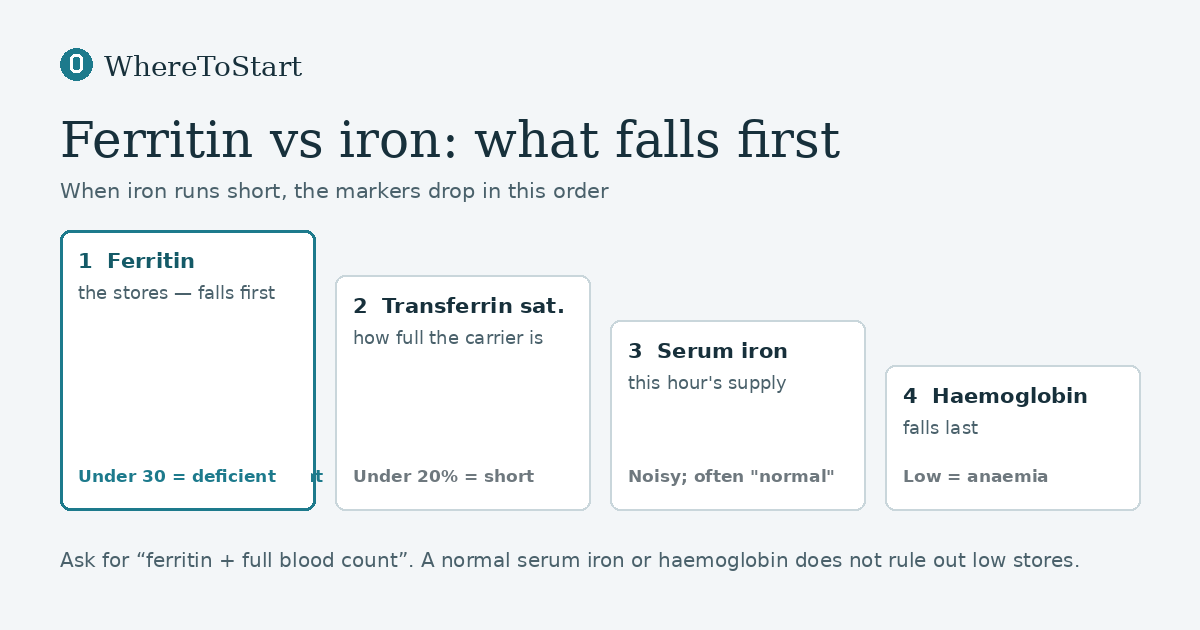
Four iron markers, and the order they fall in
An "iron test" can mean four different measurements, and the confusion between them is the reason so many people are told they are fine when they are not.
Serum iron — what is in the blood this hour
Serum iron measures the iron currently bound to transferrin, the protein that carries it around the bloodstream. It is the least useful number on the panel. It peaks in the morning and falls through the day, rises after a meal or a supplement, drops during any infection, and varies by 30% or more from one day to the next in the same person. A single serum iron result is close to meaningless on its own, and a "normal" one tells you almost nothing about your reserves. It exists on the panel mainly to calculate the next marker.
Transferrin saturation (TSAT) — how full the carrier is
Transferrin saturation is serum iron divided by total iron-binding capacity (TIBC), expressed as a percentage. Below about 20% suggests the body is short of iron to deliver to the bone marrow. It inherits some of serum iron's day-to-day noise, but it is the marker guidelines turn to when ferritin cannot be trusted (see below), and a high value is the first clue to iron overload.
Ferritin — the stores
Ferritin is the protein that stores iron in the liver, spleen and bone marrow, and the small amount in the blood tracks the size of that store. It is the single most useful test for iron deficiency, and the one every major guideline names as the test of choice: a low ferritin is diagnostic. It falls first, months before anything else moves, which is exactly why symptoms can begin while every other number is still in range.
Haemoglobin — what falls last
Haemoglobin is measured on a full blood count (FBC in the UK, CBC in North America). It only falls once the stores are gone and the marrow can no longer make enough red cells: that is anaemia. Before that point you can have non-anaemic iron deficiency — low ferritin, normal haemoglobin — which the British Society of Gastroenterology defines as a condition in its own right and which causes the same tiredness, poor exercise tolerance, hair loss and restless legs. Many "normal blood tests" are a normal haemoglobin with ferritin never measured.
So the sequence when iron runs short is: ferritin drops, then transferrin saturation, then serum iron becomes erratic, then, last, haemoglobin. Testing only the last two means catching the problem late.
The ferritin numbers that matter
Ferritin is reported in micrograms per litre (µg/L) in the UK and Canada and nanograms per millilitre (ng/mL) in the US. They are the same number, so no conversion is needed. The trouble is the reference range printed next to it. Many labs still print a lower limit of 10–15 µg/L, taken from the WHO definition of absolute deficiency — the point at which stores are completely exhausted. A ferritin of 18 will be flagged "normal" against that range, and the person will be told their iron is fine.
Clinical guidelines moved on some time ago. NICE in the UK, the British Society of Gastroenterology's 2021 guideline, British Columbia's guideline and the American Society of Hematology all treat under 30 µg/L as iron deficiency in adults, and several — BC and ASH among them — call 30–50 "probable" or "appropriate to treat" when symptoms or risk factors are present. A 2025 multinational analysis in The Lancet Global Health found that iron-restricted red-cell production begins at about 25 µg/L in non-pregnant women, which is the physiological reason the threshold has crept up.
A working summary for adults without inflammation:
- Under 15: stores exhausted; deficiency by any definition.
- 15–30: iron deficient under current UK, Canadian and US guidance, whatever the lab's "normal" flag says.
- 30–50: low-normal; worth treating if you have symptoms, heavy periods, are an athlete, are planning pregnancy or surgery.
- 50–100+: adequate stores for most people. Some symptoms-focused clinics aim higher, but the evidence for benefit above roughly 50 is weak.
- Over 300 (women) or 400 (men), or over 600 with normal CRP: not a target — a reason to check for overload or liver disease.
When ferritin lies high
Ferritin is also an acute-phase protein: it rises with infection, inflammation, liver disease, heavy alcohol use, obesity and cancer, regardless of iron stores. A ferritin of 80 during a chest infection, or in someone with rheumatoid arthritis or kidney disease, can sit on top of real deficiency. That is why a good iron panel includes C-reactive protein (CRP): if CRP is raised, guidelines lift the deficiency threshold to 70–100 µg/L and lean on transferrin saturation under 20% instead. Do not test ferritin in the middle of an illness; wait two to three weeks.
Not sure whether iron, B12 or vitamin D is the likelier gap for what you are feeling? The nutrient gap estimator weighs all three against your diet, symptoms and risk factors, and shows the free route for your country before any kit.
Getting the right test free: US, Canada and UK
The practical problem in all three countries is not cost — ferritin is cheap and usually covered — but making sure ferritin is on the form. The phrase to use is "please include ferritin and a full blood count". If you say "an iron test" you may get serum iron only, and be back where you started.
United States
With symptoms, a ferritin ordered by your primary-care clinician is a diagnostic test that insurance normally covers, subject to your deductible. Ask for ferritin plus a CBC; an "iron panel" at most US labs means iron, TIBC and saturation and may not include ferritin unless it is written separately. Without insurance, direct-to-consumer ordering is inexpensive: ferritin alone runs $10–$30 at cash prices through online resellers of Quest and Labcorp, and an iron, TIBC and ferritin panel about $25–$65, with results in one to three days after a walk-in draw. Mail-in kits cost more ($99) but bundle all four markers with a report and a nurse call.
Canada
Ferritin is an insured test in every province — unlike vitamin D — so a family doctor, nurse practitioner or walk-in clinic can order it at no charge and you take the requisition to LifeLabs, Dynacare or the provincial lab. BC's guideline tells clinicians that ferritin, not serum iron, is the test of choice and that serum iron and TIBC are not needed for a first assessment, so a Canadian requisition for "ferritin + CBC" is exactly what the guideline expects. If you have no family doctor, provincial virtual-care lines and walk-ins can write the requisition. Results usually appear in the provincial portal within a few days.
United Kingdom
Your GP can order ferritin and a full blood count on the NHS free of charge, and tiredness with a risk factor (heavy periods, a vegetarian or vegan diet, pregnancy, previous low iron) is a reasonable request. NHS labs will usually add CRP if you ask, and will not run serum iron or TIBC unless there is a specific reason — which, for deficiency, there rarely is. Expect results in about a week in the NHS App. Note that many NHS labs still print a lower limit of 15 µg/L; if your result is 15–30 and you have symptoms, that is within NICE's definition of deficiency, and it is fair to say so at the follow-up. Private finger-prick ferritin kits are around £29 and report in a day or two; they are useful if the GP wait is long or you want to track a level while treating.
Compare your options
| Option | What it measures | Cost | Turnaround | Limits |
|---|---|---|---|---|
| GP / primary care: ferritin + full blood count | Ferritin, haemoglobin, red-cell indices; add CRP | Free (UK, Canada); insured with co-pay (US) | About a week including the appointment | Ask for ferritin by name; serum iron/TIBC usually not included |
| Direct lab draw, ferritin only (US: Quest, Labcorp via online order) | Ferritin | About $10–$30 cash | 1–3 business days | No haemoglobin or CRP unless you add them |
| Direct lab draw, iron panel with ferritin (US) | Iron, TIBC, saturation, ferritin | About $25–$65 cash (Quest Health $59 + $6 fee) | 1–3 business days | Walk-in draw; you interpret it yourself |
| LetsGetChecked Iron Test (US) | Ferritin, iron, TIBC, transferrin saturation | $99 | 2–5 days after the lab receives it | Finger-prick sample; no haemoglobin; not NJ/RI |
| Welzo Ferritin Home Blood Test (UK) | Ferritin | £29 | About 1–2 days after receipt | Finger-prick; ferritin only, no CRP |
| Welzo Nutrition & Vitamin (UK) | Ferritin with B12, folate, vitamin D, cholesterol, HbA1c | £79 | About 1–2 days after receipt | Finger-prick; more markers means more to take to a GP |
| Community lab with requisition (Canada) | Ferritin + CBC (± CRP) | Free — insured in every province | 2–5 days | Needs a clinician to write the requisition |
Prices checked on each provider's site and can change; confirm before buying. Turnaround excludes postage to the lab.
What to do next
- Look at the report, not the flag. If you have had "normal iron" results, find the ferritin value. If it was never measured, that is the missing test. If it was 15–30, you are iron deficient under current guidance; if 30–50 with symptoms, it is worth discussing.
- Ask for ferritin and a full blood count by name, and CRP if you have any inflammatory condition or were recently ill. In the US, check that "iron panel" on the form includes ferritin. Do the test in the morning, before any iron supplement, and not within two to three weeks of an infection.
- Use a kit only if the free route is slow, or you want to track a level while treating. A ferritin-only kit is enough for tracking; a four-marker kit is more useful for a first look.
- Low ferritin needs a "why" before a tablet. Heavy periods, diet, pregnancy, endurance training and blood donation are common and benign. Low iron in a man, a postmenopausal woman, or anyone with gut symptoms needs a check for coeliac disease and gut blood loss first — a clinician will arrange this, and in the UK and Canada it is a priority referral.
- Re-test at three months if you start treatment. Ferritin is slow to recover; haemoglobin responds within weeks, ferritin over months, and stopping early is the usual reason it drops again.
The nutrient gap estimator checks iron, B12 and vitamin D risk together from diet, symptoms and medicines, flags anything that needs a clinician, and shows the free route before any kit.
Estimate my nutrient gapsCommon questions
Why is my ferritin low when my iron and haemoglobin are normal?
Because they measure different things. Haemoglobin falls last, after stores are used up; serum iron reflects the last few hours of intake. Ferritin reflects the reserve, and a low reserve with a normal haemoglobin is called non-anaemic iron deficiency. It causes tiredness, poor exercise tolerance, hair shedding and restless legs and is treated the same way.
What ferritin level is considered low?
Guidelines differ, and the trend is upward. The WHO uses under 15 µg/L, but NICE, the British Society of Gastroenterology, BC and the American Society of Hematology now use under 30 µg/L for most adults, with under 50 reasonable when symptoms or risk factors are present. If you have inflammation or kidney disease, under 100 can still be deficient.
Can ferritin be falsely normal?
Yes. Ferritin rises during infection, inflammation, liver disease, heavy drinking and obesity, so it can look adequate while iron is genuinely short. A CRP test run alongside shows whether inflammation is present; if it is, transferrin saturation under 20% is the better indicator, and a ferritin under 100 can still mean deficiency.
Should I take iron tablets if my ferritin is low?
Only after a clinician has asked why it is low. In premenopausal women, periods are usually the reason; in men and after the menopause, unexplained low ferritin needs a check for gut blood loss and coeliac disease before treating. Taking iron without that step can delay a diagnosis, and iron taken when not needed builds up.
Related guides
- Which vitamin D test do you actually need, and when is it free?
- At-home thyroid test or a GP blood test: which should you get first?
- At-home test matcher — which test fits what you are feeling
Sources
- World Health Organization. Guideline on use of ferritin concentrations to assess iron status in individuals and populations. 2020.
- Snook J, et al. British Society of Gastroenterology guidelines for the management of iron deficiency anaemia in adults. Gut. 2021;70:2030–2051.
- NICE Clinical Knowledge Summaries. Anaemia — iron deficiency: diagnosis and ferritin thresholds. Accessed 25 September 2026.
- American Society of Hematology. Guidelines for the diagnosis of iron deficiency — ferritin thresholds of 30 and 50 ng/mL. 2024–2025.
- BC Guidelines. Iron deficiency — diagnosis and management. Government of British Columbia. Accessed 25 September 2026.
- Rethinking ferritin thresholds: towards a physiological-based definition of iron deficiency. The Lancet Global Health. 2025.
- Dignass A, et al. Limitations of serum ferritin in diagnosing iron deficiency in inflammatory conditions. International Journal of Chronic Diseases. 2018.
- LetsGetChecked Iron Test — markers, price and state availability. Accessed 25 September 2026.
- Welzo. Ferritin Home Blood Test and Nutrition & Vitamin Blood Test — price and turnaround. Accessed 25 September 2026.
- Quest Health. Iron, TIBC & Ferritin Panel — price. Accessed 25 September 2026.
General information, not medical advice — see our medical disclaimer. Written to the WhereToStart editorial policy. Next scheduled review: .