Guides › HbA1c test at home
HbA1c at home: who should test, and what the number means
By the WhereToStart editorial team · Written to ADA, USPSTF, NICE and Diabetes Canada guidance · Last reviewed · 8 min read
This guide contains links marked Sponsored. They pay us a commission and never change our advice. How we're funded. It has not yet been independently reviewed by a clinician; here is how we check it.
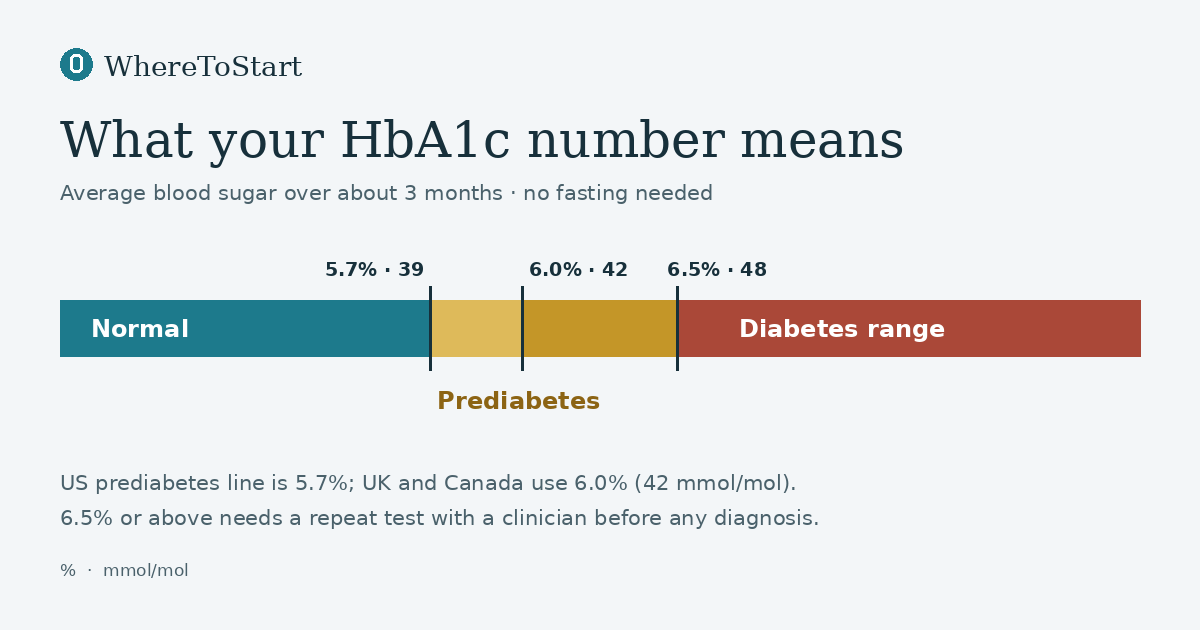
Quick answer: HbA1c shows your average blood sugar over about three months. Below 5.7% (39 mmol/mol) is normal; 5.7–6.4% (39–47) means raised risk, called prediabetes; 6.5% (48) or above suggests diabetes and needs a repeat test with a clinician. Adults 35 and over with overweight, or 40 and over in the UK and Canada, should test. It is usually free through a GP or clinic.
In this guide
Who should test — and who should see a clinician today
Type 2 diabetes and prediabetes usually cause no symptoms for years. The US Centers for Disease Control estimates that about one in three American adults has prediabetes and most don't know it; the picture in Canada and the UK is similar. That silent stretch is exactly when a simple blood test is most useful, because the changes that bring HbA1c down — weight loss, activity, sometimes medication — work best early.
The guidelines in all three countries point to roughly the same people:
- Age. The US Preventive Services Task Force recommends screening adults aged 35 to 70 who have overweight or obesity; the American Diabetes Association goes further and suggests testing everyone from 35. Diabetes Canada recommends screening every three years from 40, and the NHS Health Check in England covers 40 to 74.
- Earlier, at any adult age, if you have a parent or sibling with type 2 diabetes; a history of gestational diabetes; polycystic ovary syndrome; high blood pressure or cholesterol; a BMI over 25 (over 23 for people of South Asian, Chinese or other East Asian background); or South Asian, Black, Hispanic, Indigenous or Pacific Islander heritage, all of which carry a higher risk.
- If you're already tracking it. People with prediabetes, or with diabetes between clinic reviews, sometimes use kits to see whether changes are working.
Don't wait for a kit — get same-day care if:
- You're very thirsty, passing a lot of urine, and losing weight without trying. Together these suggest blood sugar that is already high, and in younger people can mean type 1 diabetes.
- You have those symptoms plus vomiting, stomach pain, deep or fast breathing, a fruity smell on your breath, or drowsiness. That can be diabetic ketoacidosis — call your emergency number.
- You're pregnant. Diabetes in pregnancy is checked with a glucose tolerance test, not HbA1c, through your midwife or obstetrician.
- It's for a child. HbA1c is not used to diagnose diabetes in children; see a doctor.
What the number means
Glucose in the blood sticks to haemoglobin, the protein in red blood cells, and stays stuck for the life of the cell — about three months. HbA1c measures the share of haemoglobin that has sugar attached, so it's a running average rather than a snapshot. That's why you don't need to fast, and why a few days of careful eating before the test won't change it.
| HbA1c (%) | HbA1c (mmol/mol) | What it means | Next step |
|---|---|---|---|
| Below 5.7% | Below 39 | Normal range | Retest in about three years, sooner if risk factors change |
| 5.7–5.9% | 39–41 | Prediabetes in the US; normal in UK and Canadian guidance | Lifestyle changes; retest yearly |
| 6.0–6.4% | 42–47 | Prediabetes in all three countries (the NHS calls it non-diabetic hyperglycaemia) | See a clinician; ask about free prevention programmes; retest yearly |
| 6.5% or above | 48 or above | Diabetes range | See a clinician promptly; a repeat test confirms before diagnosis |
The difference at the low end is real. The American Diabetes Association sets the prediabetes line at 5.7%; NICE in the UK and Diabetes Canada set it at 6.0% (42 mmol/mol). So the same 5.8% might be flagged in Ohio and called normal in Ontario. Neither is wrong; they balance catching people early against labelling too many. If you're in the 5.7–5.9% band, the sensible reading is "worth acting on, not alarming".
To convert, use these anchors: 5.7% = 39, 6.0% = 42, 6.5% = 48, 7.0% = 53 mmol/mol. Some reports also show an "estimated average glucose": 6.5% corresponds to roughly 140 mg/dL, or 7.8 mmol/L.
Not sure HbA1c is the test that fits what you're noticing? The at-home test matcher checks thirst, tiredness, weight change and family history against all the common tests, and shows the free route for your country first.
When HbA1c gives the wrong answer
Because HbA1c depends on red blood cells living their normal three months, anything that changes that lifespan changes the result — whether the sample is from a finger or a vein.
- Iron-deficiency anaemia tends to push HbA1c up, because older red cells hang around longer. Treating the anaemia can bring it down. If you've been told your ferritin is low, read our guide to ferritin and iron before acting on a borderline HbA1c.
- Recent blood loss, a transfusion, haemolysis, or treatment for anaemia push it down by replacing old cells with new ones. NICE advises not relying on HbA1c within two months of these.
- Haemoglobin variants such as sickle-cell trait or thalassaemia trait can interfere with some lab methods, giving falsely high or low results. If you carry one, tell the clinician; they may use a glucose test instead.
- Advanced kidney disease, some HIV medicines and high-dose vitamin C or E can also skew it.
- Fast onset. If symptoms came on over weeks, HbA1c may lag behind the actual blood sugar. A glucose test is the right tool then.
There's also the difference between kit types. Mail-in kits send a finger-prick sample to an accredited lab and are close to a clinic test. Instant meters (sold as A1C self-check kits, about $40–55 for two to four tests) give a reading in five minutes but have wider error margins. They're fine for watching a trend between appointments; they are not a screening or diagnostic test.
Getting it free: US, Canada and UK
United States
Because USPSTF gives diabetes screening a "B" grade for adults 35–70 with overweight or obesity, the Affordable Care Act requires most private plans to cover it as preventive care with no co-pay. Ask for it at your annual visit; make sure it's coded as screening. If you have symptoms or a known risk factor outside that age band, it's billed as diagnostic and generally covered subject to your deductible. Without insurance, an HbA1c ordered online from a national lab (Quest, Labcorp or a reseller) costs roughly $15–35 at cash prices for a walk-in draw — usually cheaper than a kit. Federally funded community health centers offer sliding-scale fees.
Canada
HbA1c is an insured test in every province. A family doctor, nurse practitioner or walk-in clinic can order it and you take the requisition to LifeLabs, Dynacare or the provincial lab. Diabetes Canada recommends screening every three years from 40, or earlier using the CANRISK questionnaire (available free online from the Public Health Agency of Canada). Results usually appear in your provincial patient portal within a few days. A private kit only makes sense if you can't get a requisition.
United Kingdom
Your GP can order HbA1c free on the NHS when there's a reason, and in England the free NHS Health Check offers it every five years to people aged 40–74 without a diagnosed condition (Scotland, Wales and Northern Ireland run their own checks). If your result is 42–47 mmol/mol, ask about the free NHS Diabetes Prevention Programme, a nine-month course that has been shown to lower the chance of developing type 2 diabetes. Private finger-prick kits cost around £39–49 and report within a few days; they're useful if you're under 40 with risk factors and can't get an appointment.
Compare your options
| Option | Best for | Cost | Turnaround | Limits |
|---|---|---|---|---|
| GP / primary care | Anyone with risk factors or symptoms; anyone who'll need a confirmed diagnosis | Free (UK, Canada); free as preventive care for most US plans aged 35–70 with overweight | About a week including the appointment | Needs an appointment |
| NHS Health Check (England) | Adults 40–74 without a diagnosed condition | Free | Results at or after the check | Every five years; invitation-based in some areas |
| Direct lab draw (US: Quest, Labcorp via online order) | Uninsured US adults who want a lab-quality number | About $15–35 cash | 1–3 business days | Walk-in draw; you take it to a clinician |
| Everlywell HbA1c (US) | A mail-in result without an appointment | $49 | About a week | Not NY, NJ or RI; finger-prick |
| LetsGetChecked Diabetes & Heart (US) | HbA1c plus a cholesterol panel and Lp(a) in one sample | $99 list (often discounted) | 2–5 days after the lab receives it | Finger-prick; more markers to take to a clinician |
| LetsGetChecked Diabetes (UK) | UK mail-in HbA1c with a nurse call if abnormal | About £49 | 2–5 days | Finger-prick |
| Welzo Pre-Diabetes (HbA1c) (UK) | Cheapest UK lab HbA1c | £39 | About 1–2 days after receipt | Finger-prick |
| Instant A1C meter (pharmacy) | Watching a trend between appointments | About $40–55 for 2–4 tests | 5 minutes | Wider error margin; not for screening or diagnosis |
Prices checked on each provider's site or an authorised retailer and can change; confirm before buying. Turnaround excludes postage to the lab. For every test we cover, see compare test kits.
What to do next
- Check the same-day list above. Thirst, frequent urination and weight loss together need a clinician this week, not a kit.
- If you're in an eligible group, use the free route first: your annual visit in the US, a requisition from a family doctor or walk-in in Canada, your GP or the NHS Health Check in the UK.
- Use a kit if the free route isn't open to you — under the screening age with risk factors, uninsured, or waiting weeks. Choose a mail-in kit from an accredited lab, not an instant meter, for a first test.
- Act on the band, not the decimal. Below 5.7% (39): retest in three years. 5.7–6.4% (39–47): book a clinician, ask about prevention programmes, retest in a year. 6.5% (48) or above: book promptly — a repeat test confirms before any diagnosis.
- Mention anything that could skew it — anaemia, recent blood loss, a haemoglobin variant, kidney disease — so the clinician knows whether to trust the number or use a glucose test instead.
The at-home test matcher checks your symptoms and risk factors against the tests that actually fit, flags anything that needs a clinician instead, and shows the free route before any kit.
Find my testCommon questions
Can a home HbA1c test diagnose diabetes?
Not on its own. A mail-in kit analysed in an accredited lab gives a reliable number, but every guideline requires a result of 6.5% (48 mmol/mol) or more to be confirmed, usually with a repeat venous test, before diabetes is diagnosed. Take any result of 5.7% or above to a GP or primary-care clinician.
Do I need to fast before an HbA1c test?
No. HbA1c reflects the average over roughly the last three months, so what you ate this morning makes almost no difference. That is the main advantage over a fasting glucose test. It is also why changing your diet for a few days before the test will not change the result.
What is the difference between HbA1c in % and mmol/mol?
They are the same measurement in two units. The US reports a percentage; the UK and much of Europe report mmol/mol; Canadian labs usually show both. Useful anchors: 5.7% is 39 mmol/mol, 6.0% is 42, 6.5% is 48 and 7.0% is 53.
How often should I recheck HbA1c?
If your result was normal, every three years is typical, or sooner if you gain weight or develop symptoms. If it was 5.7 to 6.4%, recheck once a year. Testing more often than every three months is not useful, because HbA1c changes slowly as red blood cells are replaced.
Related guides
- Ferritin vs iron: why a “normal” iron result can still mean you're low
- At-home thyroid test or a GP blood test: which should you get first?
- Free care routes in the US, Canada and UK
Sources
- US Preventive Services Task Force. Prediabetes and type 2 diabetes: screening. Final recommendation statement (B grade). 2021.
- American Diabetes Association. Standards of Care in Diabetes — 2. Diagnosis and classification. Diabetes Care, 2025;48(Suppl 1).
- NICE. Type 2 diabetes: prevention in people at high risk (PH38), HbA1c 42–47 mmol/mol. Updated 2017.
- NICE. Type 2 diabetes in adults: management (NG28), and NICE CKS on diagnosis — when HbA1c should not be used.
- Diabetes Canada Clinical Practice Guidelines. Screening for diabetes in adults; Definition, classification and diagnosis.
- NHS. NHS Health Check — who's eligible and what's included. Accessed 3 October 2026.
- Everlywell. HbA1c Test — price and availability. Accessed 3 October 2026.
- Welzo. Pre-Diabetes (HbA1c) Test — price. Accessed 3 October 2026.
General information, not medical advice — see our medical disclaimer. Written to the WhereToStart editorial policy. Next scheduled review: .